

Dataset and method
The current v2 development corpus contains 500 catalog records, 100 queries, and 1,442 relevance judgments in the checked-in report. The model bakeoff uses the development split and 20 measured latency samples per model. The corpus is synthetic and human-reviewed; it is not a live catalog. Judgments use grades 0-3. Hard constraints are evaluated deterministically before semantic grading. The full evaluation records dataset hashes, model identity, dimensions, run files, and limitations. OpenRouter DeepSeek is used only as an optional relevance judge; it does not generate indexed catalog text.Embedding quality
These values come fromfacilitator/handwritten-evals/reports/embedding-bakeoff-v2.json
(generated 2026-08-09). Metrics are development-split aggregates. Higher is
better.
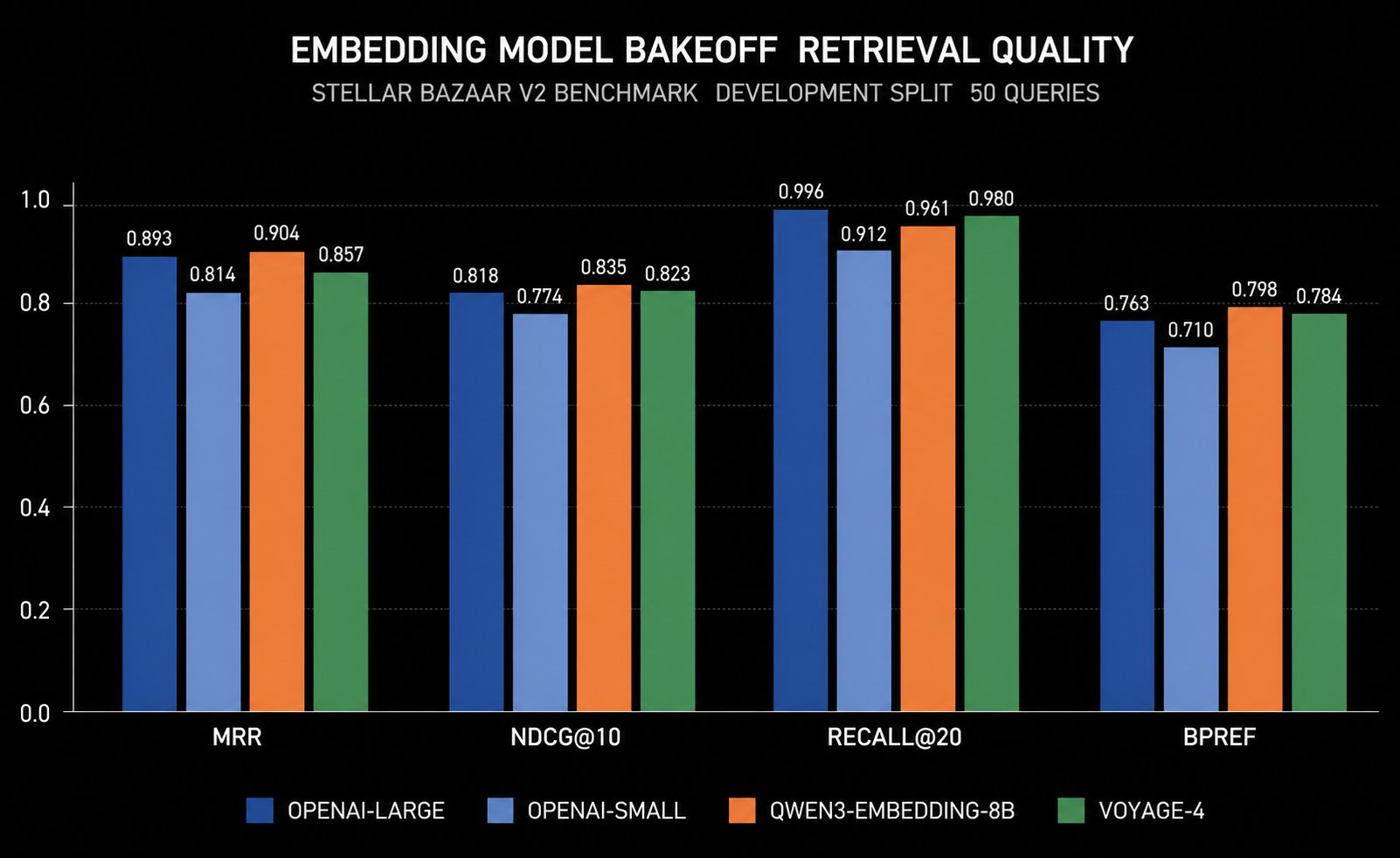
Embedding model retrieval quality on the Stellar Bazaar v2 development split.
Embedding latency
The same report measured provider latency on 20 samples. Lower is better.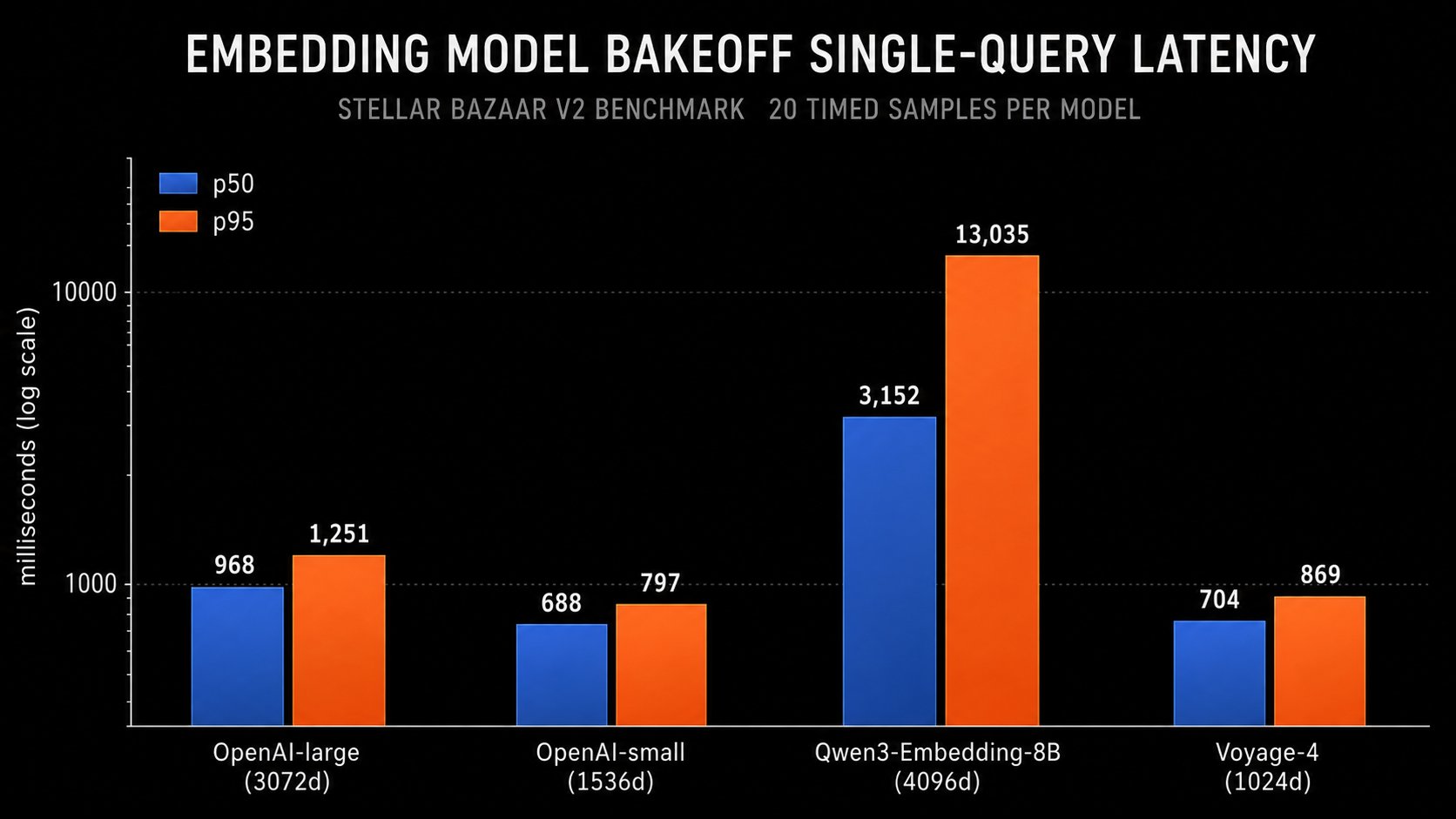
Single-query embedding latency from 20 timed samples per model.
Production search path
The real facilitator search run used PostgreSQL plus the pinned local BGE-M3 embedding path on an isolated database seeded with the benchmark catalog. The development report measured these configurations: The development report measured four production-search profiles. Real lexical scored MRR0.6121, nDCG@10 0.5334, Recall@20 0.6828, and bpref
0.5068. Real BGE-M3 semantic scored 0.8325, 0.7160, 0.8422, and
0.6837. The shipped hybrid default (0.7/0.3, rrf_k=20) scored 0.6740,
0.6114, 0.7859, and 0.5189; the tuned profile (0.2/0.8, rrf_k=6)
scored 0.8441, 0.7241, 0.8795, and 0.6907, respectively.
The tuned profile is evidence for a follow-up configuration decision, not an
automatic production change. The report explicitly notes that the development
corpus is synthetic, judgments are incomplete, and no click or payment
conversion validation exists yet.
Additional development plots
Additional development plots
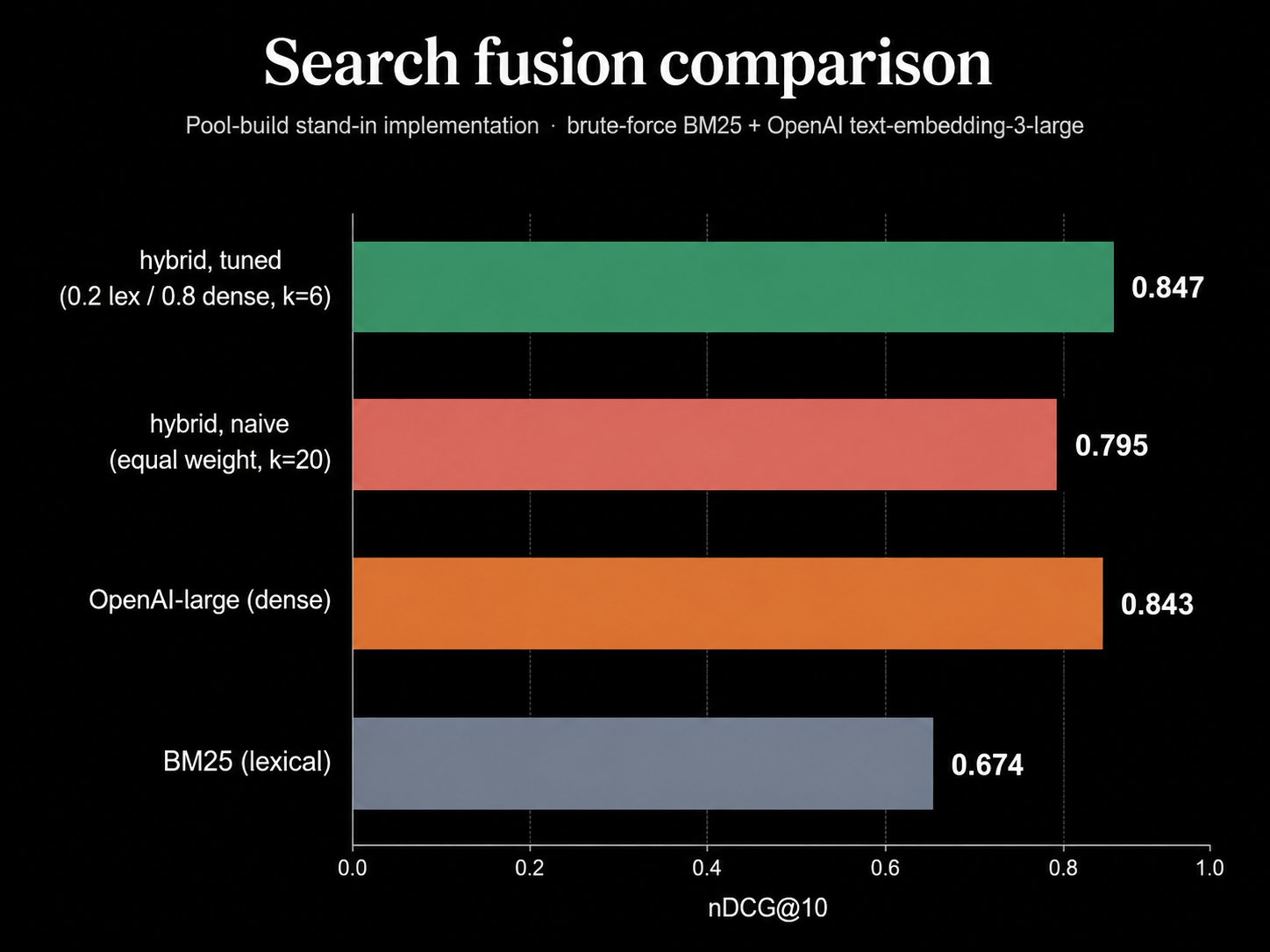
Development fusion comparison using the benchmark's pool-build stand-in.
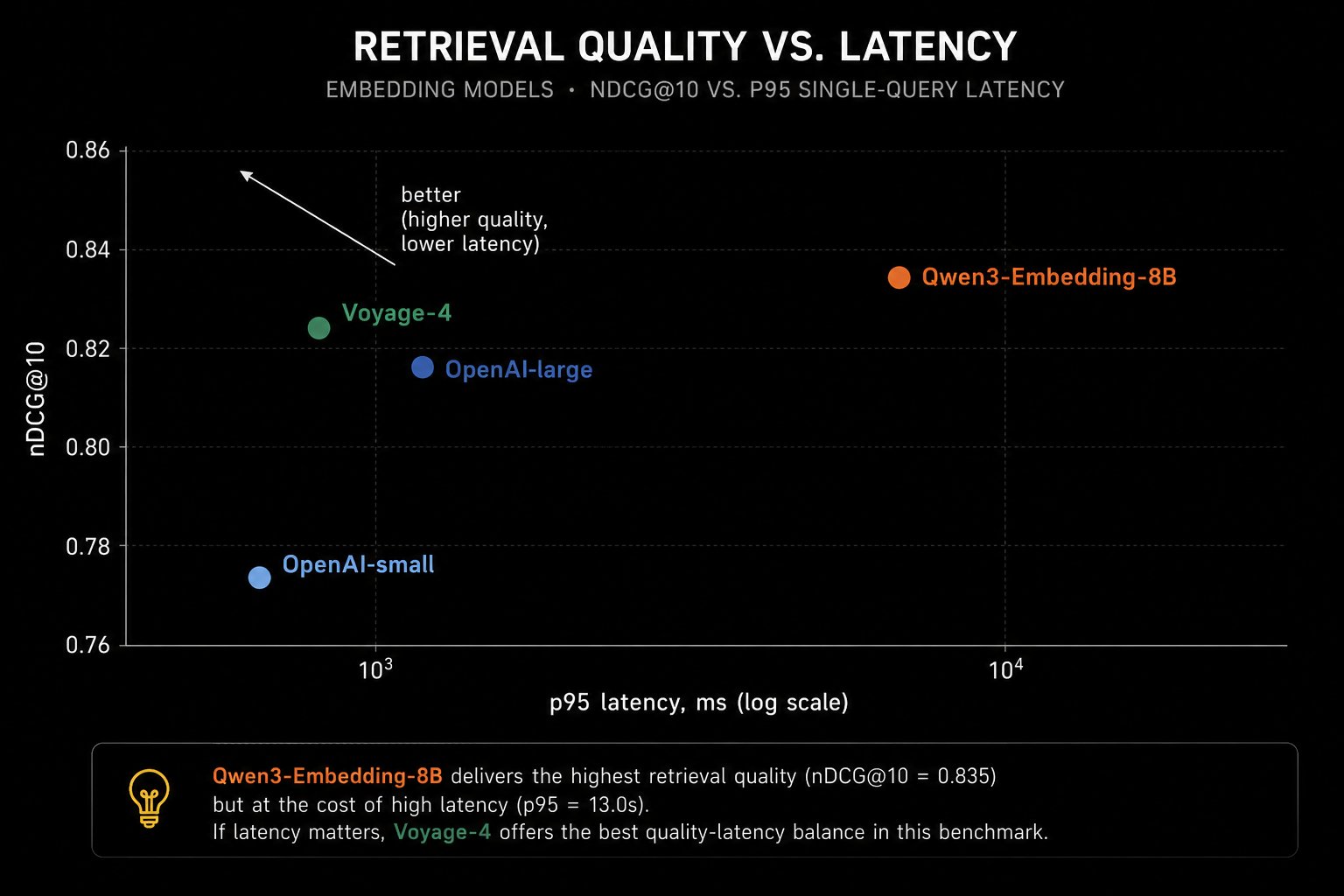
Quality versus p95 embedding latency for the development model bakeoff.
Metrics and release gates
The evaluator reports MRR, Recall@20, nDCG@5/nDCG@10, bpref, judged@k, hard-filter violations, no-result accuracy, adversarial top-1 rate, provider concentration, embedding failures, reranker lift, and p50/p95/p99 latency. The release gate requires, among other checks:- zero hard-filter violations;
- zero invalid indexed records;
- complete current run and pool artifacts;
- human calibration and adjudication evidence;
- hybrid improvement over lexical on the frozen release split;
- reranker improvement or parity when enabled;
- perfect no-result accuracy;
- adversarial listings not dominating the top result; and
- configured latency targets.
release-gates-v2.json is currently blocked because pool
snapshot, final holdout ledger, calibration/agreement, and final report inputs
are incomplete. Do not present the development table as a passed release gate.
Reproduce the evaluation
Fromfacilitator/:
facilitator/docs/SEARCH-BENCHMARK.md. Keep API keys in the environment. Never
commit OpenRouter responses containing credentials or claim generated labels as
human labels.