

stellar:testnet and stellar:pubnet, exact and
proposed upto settlement, automatic Bazaar cataloging, hybrid search, MCP
discovery, fee sponsorship, and local buyer signing. Payment correctness never
depends on an embedding provider, reranker, dashboard, or hosted Openx402
operator.
Review entry points
- Open the source repository
- Read the proposed Stellar
uptospecification - Review the
uptotestnet evidence and fee measurements - Inspect the search benchmark, runs, and reports
- Install the published Bazaar seller SDK
- Deploy the self-hosted stack on Railway
On this page
- System overview
- Facilitator and exact settlement
- Assets, trustlines, and amounts
- Stellar upto and smart-account budgets
- Bazaar catalog and search
- Search evaluation
- Clients, SDKs, and examples
- MCP discover, pay, and retry
- Hosted and self-hosted deployment
- Security and failure handling
- Transaction and conformance testing
- Configuration surface
- Maintenance and conformance
- Delivery boundary
System overview
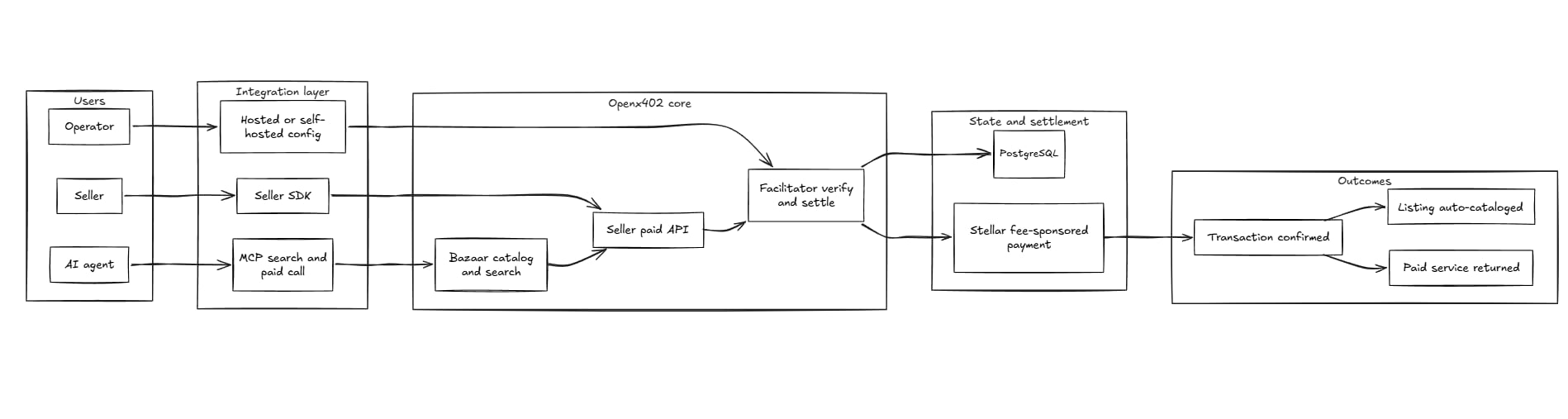
Openx402 separates seller integration, agent discovery, payment verification, settlement state, and successful outcomes.
- Seller boundary: the seller SDK compiles readable route, payment, and discovery configuration into the official x402 and Bazaar structures. The seller application executes its own code; the facilitator never proxies or executes it.
- Buyer boundary: the buyer or agent owns its signer, inspects the 402 terms, signs locally, and retries the resource request. Buyer secrets do not belong in the hosted facilitator or discovery MCP.
- Facilitator boundary: the facilitator verifies the payment, enforces operator limits, sponsors the Stellar fee, submits the exact persisted envelope, and returns a standard response.
- Bazaar boundary: valid seller metadata is cataloged after the payment decision. Invalid metadata is soft-dropped and cannot turn a valid payment into an application error.
- State boundary: PostgreSQL stores idempotency, settlement recovery, channel leases, sponsor budgets, catalog versions, search documents, embeddings, evaluation signals, and analytics.
- On-chain boundary: Stellar consumes the authorization nonce and records token movement and fees. The facilitator never becomes the source of seller funds.
Facilitator and exact settlement
Openx402 builds on@x402/stellar for canonical Stellar exact parsing and
validation. The production service adds the durable orchestration a public
fee-sponsoring operator needs: dual simulation, channel-account sequencing,
distributed idempotency, sponsor budgets, transaction recovery, and cataloging.
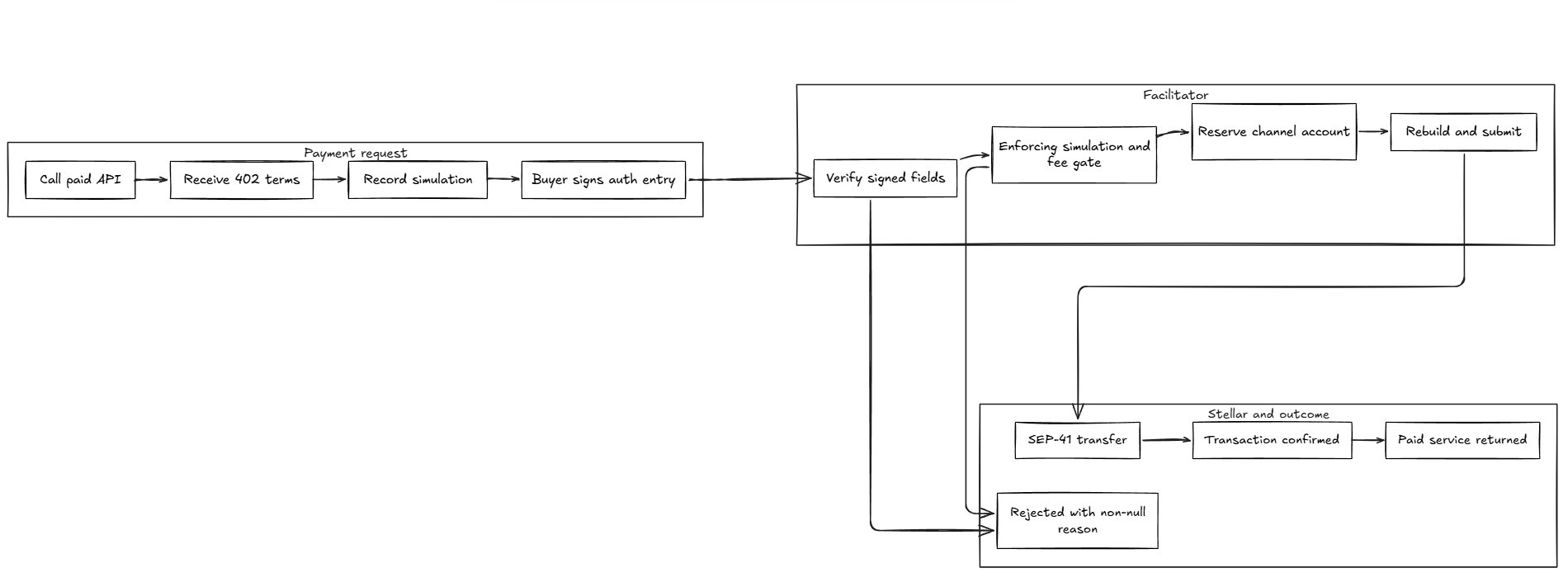
Exact payment authorization, enforcing simulation, fee sponsorship, Stellar settlement, and deterministic outcomes.
- Record simulation builds the Soroban footprint and authorization tree.
- The buyer signs the authorization entry rather than a prebuilt facilitator transaction.
- Enforcing simulation executes custom
__check_authlogic and optional contract calls before the facilitator applies its fee ceiling. - A PostgreSQL lease assigns a channel account with a fencing token. This avoids one Stellar source account becoming a sequence-number bottleneck.
- The facilitator rebuilds the verified invocation with the leased channel as source and wraps it in a sponsor-signed fee-bump transaction.
- The final envelope XDR and hash are persisted before submission. A lost RPC response causes hash polling, never blind reconstruction and resubmission.
- Every rejected x402 request returns a non-null protocol reason.
Assets, trustlines, and amounts
Openx402 treats the Stellar token contract as part of the signed payment, not as a display symbol. Operators configure an allowlist of SEP-41 contract addresses for each network. USDC is the default documented issued asset, while native XLM is reached through its Stellar Asset Contract.- Payment amounts remain integer atomic-unit strings from wire parsing through contract invocation and analytics. JavaScript floating-point values are not accepted for settlement.
- Stellar USDC uses seven decimal places. Decimals are stored with the asset configuration rather than inferred from USDC deployments on other chains.
- A classic
G...recipient needs a trustline and any required issuer authorization before receiving an issued asset. Native XLM does not require a trustline. - A Soroban
C...recipient and custom SEP-41 token may have different receive behavior. The facilitator verifies the configured token invocation and relies on enforcing simulation to detect token-level rejection. - The seller owns trustline onboarding. The facilitator and seller SDK do not create trustlines, opt accounts into assets, or bypass issuer controls.
- Fee sponsorship covers Stellar network fees only. It does not fund the payer’s token balance or create the seller’s trustline.
- Missing recipient trustline, insufficient balance, authorization-required assets, paused assets, failed token calls, and incompatible token behavior are rejected before serving the paid resource whenever simulation can prove the failure.
Stellar upto and smart-account budgets
upto lets a buyer authorize a maximum while the resource server reports the
actual amount after metered work completes. The facilitator verifies that
amount, signs it, and settles only when it is within the authorized maximum.
Stellar requires a Soroban settlement contract because a bare SEP-41 allowance
cannot enforce terminal single settlement and recipient binding.
What we have built
- We built the proposed Stellar
uptospecification and an immutable Soroban settlement contract that pulls the maximum, pays the actual amount, refunds the remainder, and consumes zero-value authorizations on-chain. - The implementation supports zero, partial and maximum settlement, atomic rollback, replay protection, concurrent submissions, optional settlement hooks, ordinary SEP-41 tokens, G-accounts, and custom
__check_authaccounts; 36 Rust tests pass and the complete testnet report is published. - Live evidence includes partial settlement, zero settlement, and a real OpenZeppelin smart-account policy flow using two context rules and actual-amount budget reconciliation.
- The design is ready for SDF and x402 TSC review; canonical upstream integration, independent audit, production fee calibration, and pubnet deployment remain grant deliverables.

The agent authorizes a cap, the smart account reserves it, the contract settles actual usage, and an optional hook reconciles the budget.
actual, which must satisfy
0 <= actual <= maximum.
An OpenZeppelin smart account uses two correlated context rules:
CallContract(settlement_contract)for the outer settlement call.CallContract(token_contract)for the nested SEP-41 approval.
maximum - actual, including the full
reservation for a zero settlement. Both hook and no-hook paths finish with the
same mandatory balance, allowance, and nonce checks. Hook execution is inside
enforcing simulation and the facilitator-sponsored fee gate.
upto caps what the seller can collect. It does not independently prove
that the seller’s reported usage was honest. Buyers must choose sellers and
metering systems accordingly.Contract lifecycle
The proposed settlement contract is immutable and administrator-free. It has no upgrade function, emergency pause, application-defined persistent state, or contract-level token allowlist. This keeps the default settlement path small and makes deployed Wasm reproducible, but it also means a defect requires a new contract deployment and facilitator configuration migration rather than an in-place upgrade. The contract instance and Wasm code are still Stellar ledger entries with TTL and rent. Operators must monitor and extend both before archival. The accepted contract address is pinned in client and facilitator configuration and published in the deployment manifest; it is not added to the x402 wire format./supported advertises only the standard scheme, network, signer, and
extra.areFeesSponsored fields. To migrate, operators publish the replacement
Wasm hash and address, stop issuing authorizations for the old address, allow
old in-flight authorizations to expire, and then switch the configured address.
The security review covers the contract, auth-entry construction, facilitator
validation, optional hook, and migration runbook.
Bazaar catalog and search
The Bazaar is an off-chain index derived from seller-declared metadata. A seller does not register separately. The facilitator observes the official discovery extension in a payment payload, validates it, records the outcome, and reports success or rejection throughEXTENSION-RESPONSES.
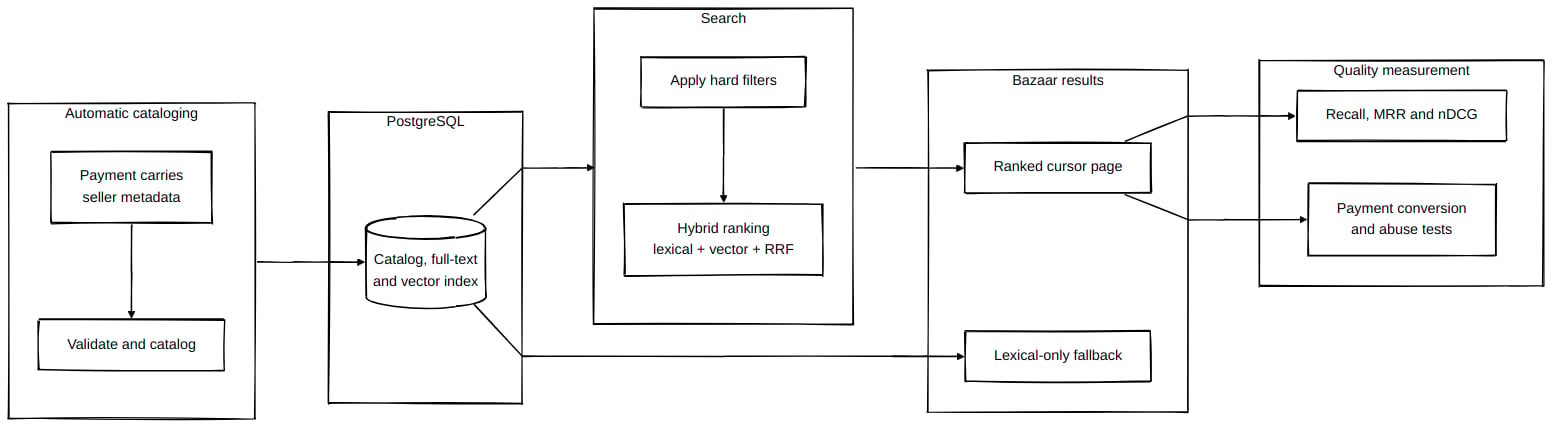
Validated seller metadata enters PostgreSQL, then hard filters and hybrid retrieval produce ranked Bazaar results and quality signals.
- HTTP resources are identified by normalized URL or route template and HTTP
method. MCP resources are keyed by
(resource.url, input.toolName). - Route templates are percent-decoded before traversal checks. Client-echoed
metadata cannot change another seller’s
payTo, asset, network, or observed payment terms. - Catalog versions and payment options are append-only. A changed recipient is quarantined rather than silently replacing the observed seller.
- Search applies supported structured constraints before ranking.
- PostgreSQL full-text retrieval and pgvector candidates are combined by reciprocal rank fusion. An optional reranker can reorder the top candidate set.
- Missing embeddings, pgvector, model access, or reranking degrades to PostgreSQL lexical search. Payment verification remains unchanged.
- Seller metadata is the only source of catalog claims. Openx402 never uses an LLM to invent a description, capability, parameter, price, or output.
Search evaluation
Search quality is measured separately from payment conformance. A relevant result does not prove a valid payment, and a valid payment does not prove good ranking. The evaluation program uses controlled fixtures for reproducibility and separately versioned ecosystem snapshots for real-world metadata coverage.1. Scrape and structure the catalog
We sampled existing Bazaar ecosystems, including metadata statistics from 14,669 live CDP x402 listings. We normalized the source data into 10 broad evaluation categories, then expanded the controlled benchmark into 20 precise capability families. Source snapshots inform coverage but are not presented as live Stellar services.2. Add realistic distractors
The v2 corpus contains 100 labeled resources and 400 independently authored distractors. Distractors include believable near-matches, sparse listings, wrong capabilities, misleading payment claims, duplicate-provider variants, and schema-valid prompt-injection text. They are compiled into official Bazaar wire metadata with the published@openx402/bazaar-sdk.
3. Write realistic agent queries
The benchmark contains 100 natural agent-style queries across capability, semantic, filtered, price-constrained, network-constrained, MCP, adversarial, and no-result cases. Query authors do not copy resource descriptions.4. Freeze and split the benchmark
The catalog and query bytes are hashed into a manifest. Queries are split into 50 development queries and a 50-query sealed release set. Development results can guide retrieval changes; the release answer key remains outside the repository so it can be used as a true holdout.5. Build the candidate pool
BM25, brute-force exact dense retrieval, and exact hybrid retrieval contribute their top candidates. The pool is deduplicated and audited against related but unpooled resources. Production PostgreSQL lexical, semantic, and hybrid search are scored against this pool rather than defining their own ground truth.6. Grade relevance independently
Every pooled(query, resource) candidate is sent to two blind, independent
LLM grading contexts. They cannot see system identity, rank, score, authoring
context, or the other grader’s decision. Grades use this rubric:
7. Compare retrieval systems
The benchmark compares BM25, dense retrieval, production lexical search, semantic search, and weighted hybrid RRF. It tests multiple embedding models and RRF parameters. Reranking remains pluggable, but the v2 MVP release score does not claim a reranker result until a real configured provider is evaluated. Metrics include nDCG@10, MRR, Recall@20, bpref, judged@10, hard-filter violations, no-result accuracy, and adversarial resistance.8. Measure production trade-offs
Quality is reported alongside query-embedding and end-to-end search p50/p95/p99 latency, indexing time, throughput, provider cost, embedding dimensions, vector storage, model availability, and infrastructure needs. A model with higher relevance but interactive latency that is too slow does not become the production default automatically.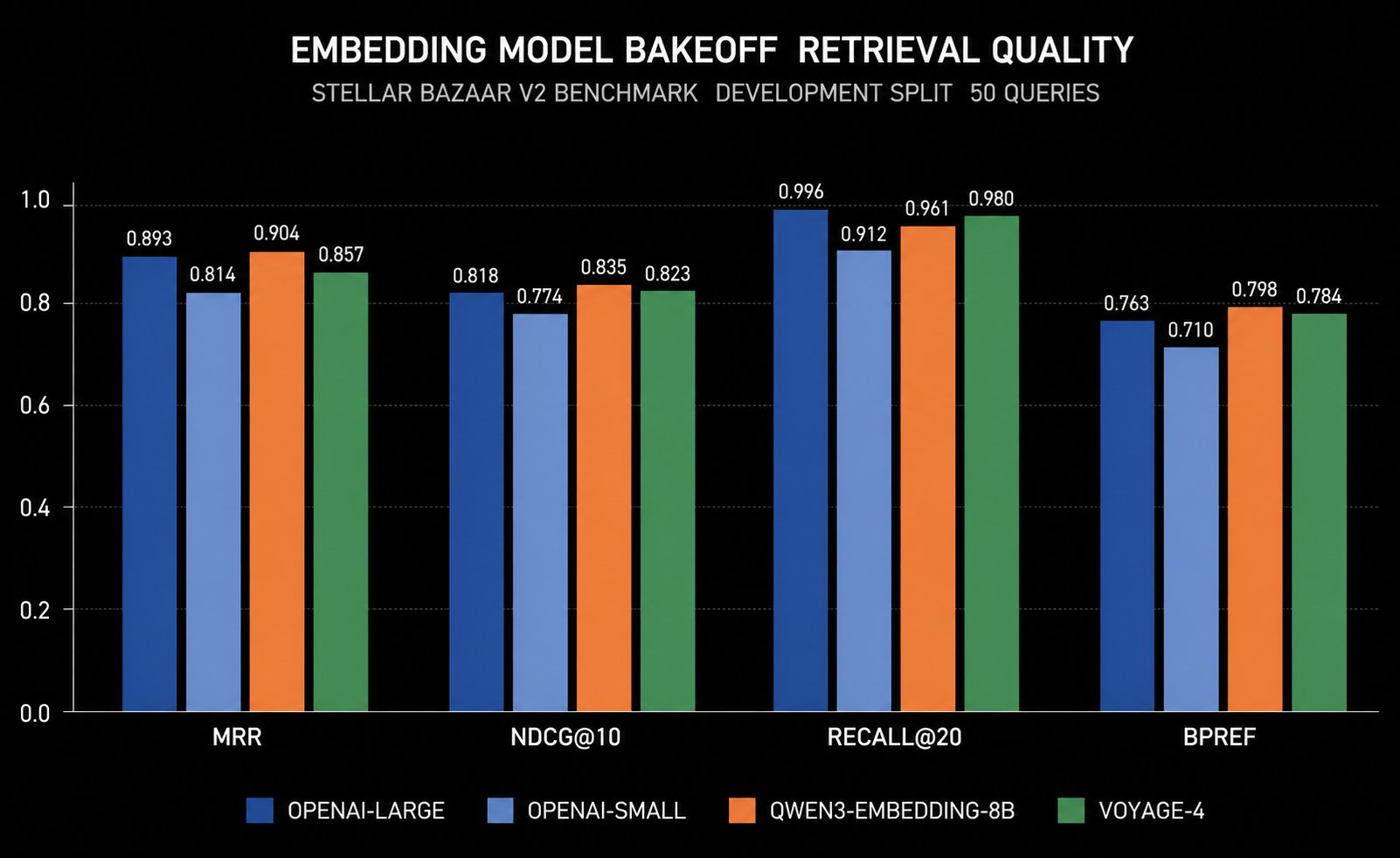
Measured retrieval quality for four embedding models on the v2 development split.
Online evaluation and maintenance
The hosted service records search impressions and settlement outcomes in PostgreSQL without changing seller-authored metadata. We will maintain the evaluation program through:- continuous p50/p95/p99 latency, zero-result, partial-result, fallback, embedding-failure, and reranker-failure monitoring;
- result-to-paid-call conversion measured by query class, provider, network, scheme, and resource type;
- provider-concentration, new-provider exposure, stale-listing, and adversarial-ranking checks so conversion does not become an unchecked popularity loop;
- daily operational dashboards and alerts, plus scheduled offline benchmark runs against the development set;
- sealed release-set scoring before a search production tag;
- a new model generation, dimension record, vector generation, and explicit reindex whenever an embedding model changes; and
- versioned benchmark manifests, model revisions, prompt hashes, configuration, hardware, and limitations in every published report.
Clients, SDKs, and examples
The repository is one implementation with separate packages and deployment boundaries. A seller, buyer, agent, or self-hosting operator installs only the surface it needs.- Paid HTTP seller example
- Canonical exact buyer guide
- Seller SDK guide and route factory
- Self-facilitating resource server
- Paid MCP seller fixture
uptoclient guide
MCP discover, pay, and retry
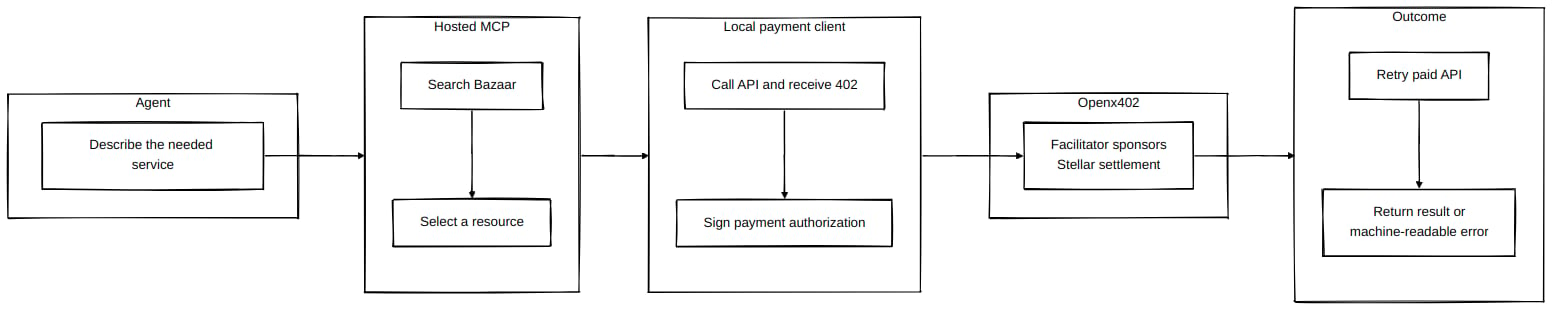
Hosted MCP performs discovery; a local buyer component owns signing and paid execution.
- The hosted MCP exposes discovery and resource inspection without a payer key.
- A local or private signer-enabled MCP can call the seller, receive 402 terms, sign locally, settle, and retry.
- The MCP process consumes public facilitator APIs. It does not import facilitator internals or connect directly to the facilitator database.
- Inputs and outputs are structured. Every failure has a stable, machine-readable code and non-null reason.
- Independent local budgets compose with the signed x402 maximum and optional on-chain smart-account policy.
- Paid execution enforces SSRF controls, redirect limits, response-size limits, network allowlists, and per-call and cumulative budgets.
Hosted and self-hosted deployment
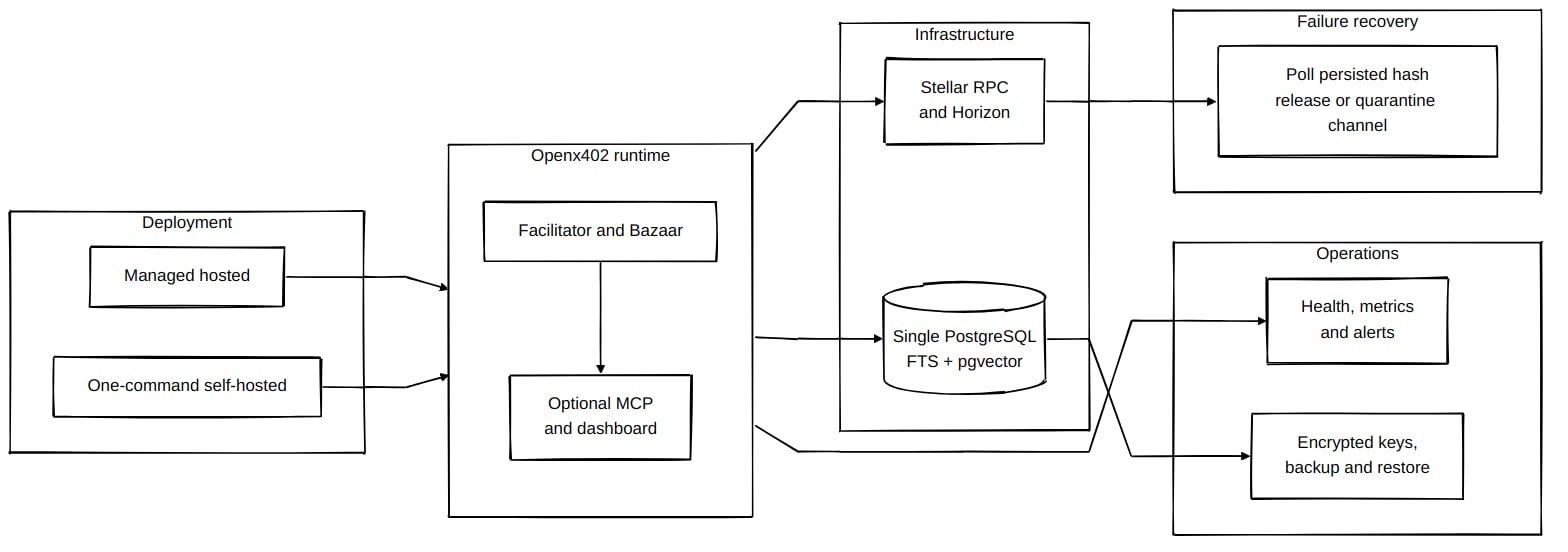
Hosted and self-hosted profiles run the same Openx402 implementation with PostgreSQL, Stellar connectivity, monitoring, and recovery.
- Required services: one facilitator process and one PostgreSQL 17 instance. PostgreSQL provides full-text search, pgvector, queues, leases, budgets, idempotency, analytics, and encrypted key storage.
- Optional services: MCP and dashboard processes. Their failure cannot weaken verification or settlement.
- Zero-key testnet: an explicit development mode creates sponsor and channel accounts, encrypts the keys, and funds them through Friendbot.
- No model requirement: self-hosting boots without embedding or reranking credentials and continues with PostgreSQL full-text search.
- Pubnet fail-closed: settlement does not start without configured sponsor keys, approved assets, reviewed contract addresses, and measured fee limits.
- Replica-safe operation: PostgreSQL leases, fencing tokens, global sponsor budgets, and idempotency records work across multiple facilitator replicas.
- Portable packaging: the same configuration schema and service package run in local Node.js, Docker Compose, Railway, or an embedded resource server.
- Independent images: the facilitator, MCP, and optional dashboard use separate process boundaries. Docker Compose and the Railway template orchestrate them; a Dockerfile does not start several unrelated services.
- Forward-only data management: numbered PostgreSQL migrations run before service readiness. Backup, restore, encryption-key recovery, and model reindex procedures are operator responsibilities with documented commands.
- Air-gapped behavior: the stock self-hosted image does not download model weights. Lexical search works without outbound model access; an operator must explicitly package and pin any local model runtime and weights.
Security and failure handling
actual <= maximum, allowance equality,
enforcing simulation, expected exact-transfer events, upto balance and event
deltas, replay checks, canonical Bazaar validation, rejection reasons, or wire
compatibility.
Read the security model,
catalog threat boundary,
and upto threat model.
Transaction and conformance testing
Acceptance is tested at the wire and ledger levels rather than inferred from unit coverage.- Canonical exact tests use the stock x402 client and the standard
{ transaction }Stellar payload against the running facilitator. - Facilitator tests cover
/verify,/settle,/supported, authentication, limits, idempotency, channel leasing, fee sponsorship, unknown transaction recovery, Bazaar cataloging, discovery pagination, and search degradation. - Contract tests cover zero, partial, maximum, negative, above-maximum, and
i128::MAX; approval/pull/pay/refund failures; atomic rollback; zero leftover allowance; replay; changed actual; concurrent settlement; hooks; and custom accounts. - Real-auth OpenZeppelin tests use signed auth entries. They do not rely on
mock_all_auths()ormock_auths(), which would skip__check_authpolicy execution. - Token testing includes ordinary SEP-41, a different-decimal contract, authorization-restricted SAC accounts, and a clawback-capable SAC. Live issued-USDC and broader unusual-token coverage remain explicitly pending.
- Discovery tests cover schema soft-drop, percent-decoded route traversal, cross-seller spoofing, MCP tuple identity, append-only pricing, catalog staleness, and cursor stability across simulated replicas.
- Search tests cover hard-filter violations, known-item retrieval, no-result behavior, adversarial metadata, frozen manifests, blind judgments, and production retrieval latency.
- MCP tests cover deterministic tool I/O, budgets, SSRF and redirect limits, response bounds, signer modes, search, selection, and paid retry behavior.
upto transactions. Official canonical upto, exact and
upto pubnet hashes, the four-profile x402 E2E report, and external review are
remaining acceptance gates.
Review upto conformance evidence, the
root evidence table,
and security release gates.
Configuration surface
The implemented configuration surface includes:- networks, RPC/Horizon endpoints, approved SEP-41 assets, sponsor/channel accounts, fees, maximum amounts, and timeouts;
- caller authentication, rate windows, concurrency, sponsored-fee budgets, settlement polling, and unresolved-settlement backpressure;
- automatic cataloging, index-on-verify or index-on-settle, metadata bounds, staleness, retention, and discovery pagination;
- lexical, semantic, and reranking providers, model identity, dimensions, weights, timeouts, candidate counts, and fallback behavior;
- channel-pool size, lease timing, pending-settlement limits, and minimum sponsor/channel balances; and
- analytics enablement, query-impression retention, and address redaction.
Maintenance and conformance
Openx402 treats conformance as a continuing release obligation:- pin x402 package versions and monitor the Foundation repository for spec, extension, transport, and E2E harness changes;
- run unit, integration, wire-shape, canonical-client, and official x402 E2E tests before each release;
- publish
/supported, package versions, contract addresses, commands, rejection fixtures, and transaction hashes in conformance reports; - re-run both networks and both schemes when a settlement package, Stellar SDK, contract, or wire specification changes;
- monitor contract instance and Wasm TTL and extend them before archival;
- run dependency-license checks and reject AGPL or strong-copyleft additions;
- publish security advisories, compatibility status, and remediation notes; and
- maintain seller, buyer/agent, operator, and protocol-contributor guides with runnable examples.